Ad Technologies

The best SSPs for publishers help maximize ad revenue by increasing competition, improving fill rates, and connecting inventory to premium demand sources.
Your ad monetization success hinges on many moving parts - the teams you work with, the metrics you track, the platforms you use, and the ad formats you run. Among all these, SSPs (supply-side platforms) stand out as one of the most powerful pieces of the puzzle.
A strategically chosen SSP does more than just facilitate transactions. It acts as a magnifying lens, connecting you with the best demand partners, networks, and advertisers while ensuring your inventory is always working hard for you. The right SSP means better advertising partners, stronger revenue, and a seamless, high-quality ad experience for your users.
We are here to help you find that SSP, one that puts you in control and transforms your programmatic strategy from a guessing game into a consistent win.
But first, let's cover the basics.
An SSP, often known as a supply-side platform or just a supply platform, is a programmatic technology platform that helps publishers sell, manage, and maximize their inventory of digital ads.
Like most publishers, you most likely started your adventure using AdSense as your primary source of income. Sending bid requests to Google, one demand partner, is what happens when you use AdSense.
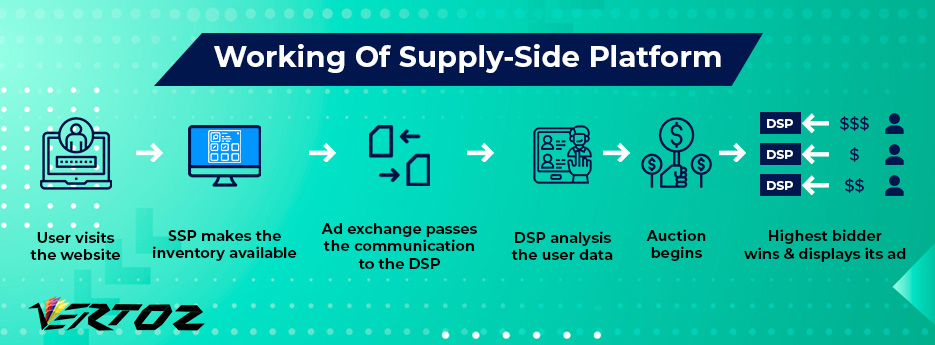
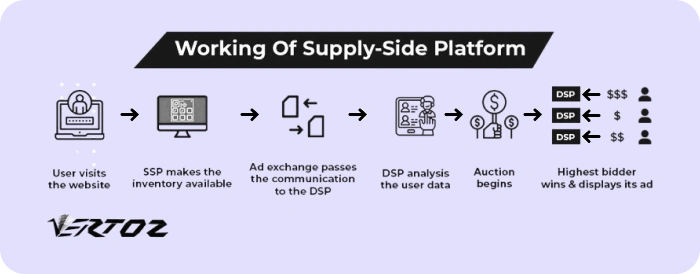
However, with SSPs, publishers can use a single platform to send bid requests to several demand partners. These consist of the DSPs, exchanges, and ad networks to which the SSP is linked.
What makes an SSP desirable? By making the product available to multiple purchasers, you've effectively diversified your revenue streams in one stroke. In turn, you have a better chance of attaining an improved fill rate and overall yield!
At the risk of stating the obvious, here is the difference between these three -
Imagine SSPs as the master chefs who ensure your kitchen is stocked with top-quality ingredients (ad spaces), Ad Networks as the friendly neighborhood bakers who craft delightful treats (ads) using those ingredients, and Ad Management as the seamless recipe bookkeeping everything organized.
SSPs focus on maximizing revenue from your ad spaces, Ad Networks connect you with advertisers, and Ad Management ensures the entire baking process runs smoothly. It's like building a delicious advertising ecosystem—SSPs bring the groceries, Ad Networks whip treats, and Ad Management keeps the kitchen chaos at bay.
Now that we have covered the bases, let’s move on to details!
Choosing an SSP is already a difficult task. So, how can you make sure you are choosing the best?
Here is what makes a good SSP.
To enable publishers to raise the visibility of their inventory and optimize revenue from the sale of their advertising spaces, SSPs come with integration options with many demand sources.
Make sure yours does as well.
This KPI calculates how often advertising spaces are allotted/left vacant. It’s an essential component of an SSP since it informs publishers of how well their advertising space sales are going. Higher fill rate along with higher CPM - you have got the best SSP.
An SSP that can offer dynamic and static ads that fit inside their advertising space is a viable option for publishers.
An intuitive dashboard is a must for any outstanding SSP, enabling publishers to effortlessly manage their inventory and quickly assess the monetization performance at any moment.
Beyond the initial technological integration procedure between the SSP and the publisher, this technical assistance must be sustained over time.
Why? To quickly address any difficulties that may come up about the kind of integration, traffic entry, inconsistencies in reporting, response times, etc. To answer any questions or concerns, there should always be thorough communication between the publisher and the technical team.
So, before you choose one, ensure the “ONE” checks all the boxes!
Many SSPs can be effective monetization partners for particular formats, while others may function well in markets.
You already know what makes a good SSP. But what else should you consider before making the final choice?
The ad sector is expanding quickly. To be at the forefront of change, publishers should surround themselves with creative ad tech partners who are strong innovators and in step with industry trends.
Innovation for SSPs can take many forms, such as solutions for addressability, curation, and sustainability. Did you know that one million ad impressions equal one metric ton of carbon dioxide?
That means one round-trip ticket from Boston to London. Most people are unaware of the amount of carbon dioxide that the internet generates, and the moment has come to decarbonize the programming supply chain.
Sustainability is now a necessity and not optional, and make sure your SSP knows that!
Ask yourself. Does my SPP help generate robust revenue?
A publisher needs partners that can monetize its inventory and bring in a robust cash stream if they want to succeed. SSPs can aid publishers in various ways, like attracting premium demand through direct links and optimizing it using AI to increase income.
Additionally, since AI's capabilities advance regularly, savvy SSPs created their algorithms to assist publishers in structuring revenue.
You want to collaborate with SSPs who share your high standards of excellence since, as a publisher, you have high expectations for yourself. But how can you tell if an SSP can shield you from malvertising, in which unscrupulous parties secretly introduce malware and other dangerous code into respectable ad creatives?
Several reliable third-party verification partners are available nowadays that provide SSPs quality measuring options. Verified SSPs that can offer a high-quality, brand-safe environment shouldn't be disregarded.
It's common knowledge that advertisers want partnerships with publishers that can deliver exceptional campaign results and excellent user experience. As a publisher, you need to allocate ad placements to maximize view and interaction rates for brands while also considering user privacy.
Some SSPs are well-suited to assist publishers in achieving the best possible user experience and ad performance using various techniques, including attention measurement and ad upgrades. Ultimately, improved user experiences with ads result in increased income for publishers.
Transparency in SSPs is an additional crucial consideration. Publishers can ensure timely payment and prevent payment-related problems by selecting financially sound monetization partners.
Transparency and open communication are essential for publishers and SSPs to have a positive working relationship. It's critical to give publishers accurate data so they can decide on the right ad strategy.
Choosing the SSP that best suits your needs might be challenging because their product offers are often similar. Here are our favorites.
It’s an Amazon-owned supply-side platform that incorporates Amazon's vast data and processing resources to present your website visitors with the most pertinent advertisements. However, remember that Amazon is ranked third among the most often used digital advertising platforms.
Pros:
Cons:
Best for - Publishers with a significant portion of their audience interested in Amazon products or services.
For publishers looking to monetize content on their websites and applications, Xandr offers a more reliable SSP to trust. Publishers can use private or open auctions to sell their ad inventory by contacting hundreds of demand partners through Xandr.
Major publishers such as Microsoft News, CNN, Ouest France, Schibsted, Seattle Times, and are already selling their ad space through this platform.
Pros:
Cons:
Best for - Publishers with established relationships with premium advertisers and a focus on private marketplace monetization.
The mission of Pubmatic's SSP for publishers is to provide them access to the open internet and help them engage with high-end advertising globally. This supply-side platform's features, which include a transparent bidding procedure, contemporary ad formats, and a strong header bidding strategy, are all designed to enable higher monetization.
Pros:
Cons:
Best for - Publishers with complex website structures or diverse audience segments seeking granular control over header bidding implementation.
With the help of OpenX, an SSP, publishers can negotiate higher rates for ads displayed on their websites. Additionally, it allows advertisers greater discretion over the placement of their adverts.
OpenX is one of the top SSP networks for publishers and advertisers because of several capabilities it provides. Its main attributes include multiple ad types, sophisticated targeting, and real-time bidding.
Pros:
Cons:
Best for - Publishers with a significant European audience base or those targeting niche markets within the European region.
One of the most popular and reliable full-service platforms, Google Ad Manager has a robust ad server and SSP. The platform allows publishers and app developers to sell their ad inventory and gain access to Google AdX, the company's premium advertising exchange.
You can monetize your ad inventory by running rich media, video, and display advertising using Google Ad Manager.
Pros:
Cons:
Best for - Publishers who heavily rely on Google products and services within their ecosystem and prioritize data-driven monetization strategies.
Magnite (formerly Rubicon Project + Telaria merger) stands as the world's largest independent sell-side advertising platform and a consistent top-ranked SSP in 2025–2026 industry reports and publisher guides. It leads in coverage across durable supply chains (e.g., 95.7% in key DSP spend metrics per Jounce Media), dominates CTV/video monetization (often #1 or near-top in streaming/live sports), and holds an estimated 25% U.S. SSP market share as the premier non-Google option.
Pros:
Cons:
Best for - Publishers prioritizing CTV/video/streaming revenue, those seeking an independent alternative to Google with strong premium demand access, or scaling in high-growth channels like live sports and connected TV. It's frequently listed among the top 5–10 SSPs in 2026 publisher recommendations for its scale, innovation, and ability to maximize yield in evolving programmatic landscapes.
Popular supply-side marketplace Media.net is supported by Yahoo & Bing. Because it gives publishers access to keyword-targeted advertising, this SSP is very well-liked by them. You can sell your ad inventory to niche advertisers at the best price by connecting with them with Media.Net.
Pros:
Cons:
Best for - Publishers looking to expand their reach beyond traditional markets and tap into the potential of emerging economies.
Kevel provides publishers with a strong SSP and an ad-serving API that makes it easier to build a supply-side platform. With Kevel's SSP, publishers may make API calls to create bespoke SSPs without requiring complicated procedures or technical know-how.
Pros:
Cons:
Best for - Technically adept publishers with in-house development resources seeking complete control and customization over their ad-serving infrastructure.
Choosing SSPs to access your inventory can be challenging. Still, you can make an informed choice by assessing an SSP's ability for innovation and staying on the cutting edge, as well as its capacity to generate revenue and meet quality standards.
You can also decide whether an SSP can offer a more comprehensive ad experience while enhancing performance. Lastly, you can consider how transparent its business practices are.
Knowing the best SSP and then connecting with it is really important, especially when you are planning to in-house your ad management. But as is quite relevant from our above list, each SSP comes with its own set of requirements. Connecting with them is another turf to conquer.
Daunting, isn’t it? Not with Mile. Whether you want to outsource ad management or build your in-house ad tech stack, we are always there with our services. We work with the best SSPs for premium demand and high-quality ads, and it will be our pleasure to connect you with them. Contact us today, and we will do the rest.

A supply-side platform (SSP) is programmatic advertising software that helps publishers sell and optimize their ad inventory in real time. It connects websites and apps to multiple demand sources, including DSPs, ad exchanges, and ad networks, to increase competition for impressions. SSPs improve fill rate, CPM, revenue yield, and reporting transparency while supporting formats like display, video, CTV, and mobile ads.
To choose the best SSP for your website, evaluate demand partner integrations, average fill rate, CPM performance, transparency, reporting tools, and ad format support (display, video, CTV). Ensure it supports header bidding, complies with privacy laws (GDPR, cookie consent frameworks), protects against malvertising, and does not negatively impact Core Web Vitals or page speed.
An SSP (supply-side platform) helps publishers sell ad inventory programmatically, while a DSP (demand-side platform) helps advertisers buy ad impressions across multiple publishers. SSPs maximize publisher revenue by creating auction competition; DSPs optimize advertiser targeting, bidding, and campaign performance. Together, they power real-time bidding in the programmatic advertising ecosystem.
Yes, publishers can use multiple SSPs simultaneously, often through header bidding or server-side auctions. Using multiple SSPs increases competition among buyers, improves fill rate, and can raise CPMs. However, proper setup is essential to avoid latency issues that may harm user experience, Core Web Vitals, or page load speed.

.webp)


.avif)
.avif)