Ad Technologies
Bid Shading - Is Price Floor A Lost Game for The Publishers?
min read
February 26, 2026

By
Abhilasha

Ad Technologies

Bid shading optimizes first-price auctions for advertisers by lowering bids to the minimum needed to win. Over time, this precision compresses publisher CPMs.
Cognitiv created a stir in the market with its research on Bid Shading - $6.6 Million left on the table by advertisers. Claiming it to be a blunt and unsophisticated tool, the research revealed -
“A third of Digital Media Buyers do not even know that bid shading exists, with only 35 percent of Digital Media Buyers “extremely confident” in their understanding of how a bid shading algorithm works and that they could explain it to others. Yet, 70 percent are paying an extra fee for this tool that they do not fully understand, blindly trusting that it is saving them money.”
Programmatic advertising is a complex interplay of outdated technologies and cutting-edge innovations, presenting both significant opportunities and hidden pitfalls. The ability to identify and leverage the optimal solution is paramount. To navigate this intricate terrain, a deep understanding of the buy-side pricing mechanism is essential.
This includes strategies like bid shading, a technology that employs predictive algorithms to optimize bidding strategies. By analyzing historical placement clearing prices and comparing them to a buyer's maximum willingness to pay, bid shading algorithms can determine the optimal bid amount. This intelligent approach enables buyers to secure ad placements at competitive prices while maximizing their return on investment.
To gain a deeper understanding of the ins and outs of bid shading – we will be explaining the bid shading from a different angle! Let’s get started
Bid shading is the algorithm-based solution with which DSP (and some SSPs) set the average bid for each impression, thus saving advertisers from overspending. It helps advertisers win impressions on ad space at the lowest possible price while still achieving their campaign goals.
Bid shading evolved out of necessity when the “second-price auction” transitioned to the “first-price auction”.
Also called the Vickery auction, the mechanism works backward. Advertisers will bid whatever they think the ad inventory is worth. However, the winner will have to pay just $0.01 over the second highest bid.
Suppose there are four qualified bidders in an auction. Bidder A bids $4, B bids $5, C bids $2, and D bids $8. The winner here, of course, will be bidder “D,”. But now he will be paying $5.01 for the same inventory instead of his initial bid of $8.
Although the second-price auction created a competitive environment for the publishers, it also created the probability of money being left on the table. The second-highest bid might not be the correct market value of their inventory.
A sealed-bid auction, the bidders here submit their bids, and the highest bidder wins and pays their exact bid amount.
So, if we consider the same example shared above, here, the winning bidder will be Bid “D” and the amount to be paid will be $8.
This change demands more strategic bidding from advertisers, as they risk paying their full bid amount.
The direct correlation between bid and payment can lead to higher revenues per impression initially, as advertisers bid aggressively post-shift (e.g., Google's 2019 transition saw RPM rise before shading matured). However, effective bid shading later reduced publisher CPMs by 15-20%.
However, the transition also requires publishers to price their inventory more accurately, as overpricing can deter bidders while underpricing can lead to revenue loss. The increased revenue potential comes with the need for greater market insight and pricing strategy refinement.
Bid shading works on algorithms. It analyzes a vast array of data points, including historical bidding data, the specific characteristics of the ad inventory, and real-time bidding dynamics. With this, the algorithms calculate a bid that is strategically lower than what the advertiser would be willing to pay in a maximum bid scenario but still competitive enough to win the auction.
The "shaded" bid, therefore, represents a compromise between the outright aggression of a first-price auction bid and the bargain-seeking nature of a second-price auction bid.
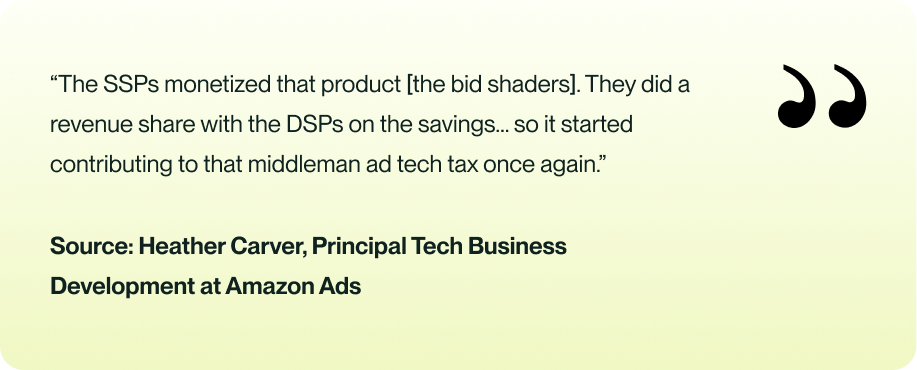
Introduced by DSPs and some SSPs, bid shading emerged as advertisers' response to first-price auctions. The goal is to find the sweet spot where the bid is still high enough to win the impression most of the time but low enough to avoid overpaying significantly. And the platforms will take their share out of the amount saved per campaign.
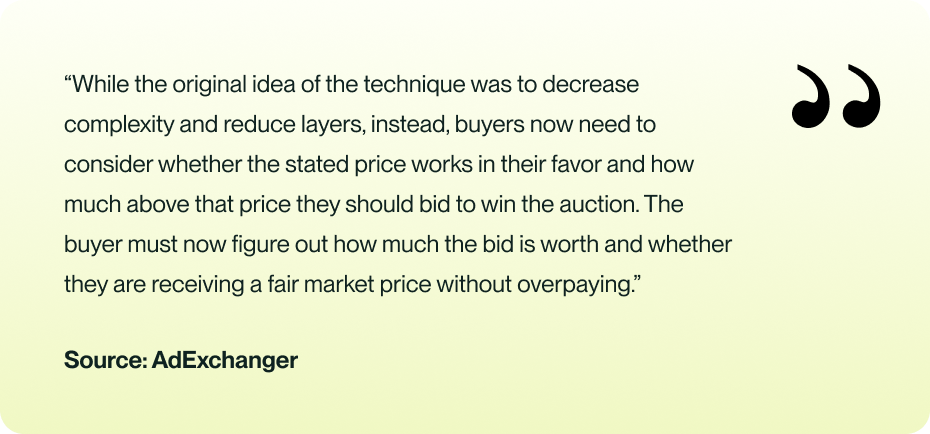
Bid shading, a cost-saving move by advertisers in programmatic auctions, might save brands a few bucks, but it’s a thorn in the side for publishers. By letting buyers bid just enough to stay competitive without overspending, it chips away at publisher revenues. So, what’s the counterpunch?
Price floors!
Here’s why smart publishers are leaning on price floors to keep the revenue flowing:
Bid shading in programmatic advertising is just one of many challenges. Price floors give publishers a tool to level the playing field, reclaim pricing power, and safeguard their ad inventory’s value.
Staying ahead means staying strategic, set your floors wisely, keep an eye on the market, and watch your revenue climb.
Loss or no loss, one thing is sure. The way buyers bid for your inventory has advanced for Good. Now, it’s time for you to ramp up and respond.
The market today is ruled by those who are ready to adapt to advancement. It’s time to flex the algorithmic muscle.
Dynamic flooring is one such technology that you can use to claim your power in the pricing ecosystem. Solutions like Mile’s Dynamic Flooring are built on ML modules. Here, the algorithm goes deep into granularity-
Result- inventories sold at their best market price!
Mile’s Dynamic Flooring is available for the Prebid environment. You can use UPR for GAM.
By sharing data and insights, publishers can gain a more comprehensive view of the advertising ecosystem, including advertiser behaviors, market trends, and pricing strategies. This collective intelligence can enhance publishers' bargaining positions and enable more informed decision-making.
Utilize technology like AI to personalize the ad experience based on user context, preferences, and real-time behavior. Create a more immersive and engaging experience for users and potentially command premium pricing.
Success is always there. The question is how willing you are to innovate and push the boundaries.
Embrace data-driven insights, explore unconventional solutions, and continuously adapt to the ever-evolving landscape. This strategic standoff can only shape the balance of power, pricing dynamics, and, ultimately, the revenue outcomes in digital advertising markets.
By taking charge of innovation, you can transform from passive participants to active players, ensuring your voices are heard and your value is recognized in the digital advertising game.

Bid shading in programmatic advertising helps advertisers navigate first-price auctions by predicting optimal bids lower than their max willingness-to-pay. By leveraging historical bid data and impression value estimates, this technique recalibrates bids, enabling advertisers to win impressions without overpaying. At its core, bid shading relies on algorithmic efficiency, analyzing bid history, ad size, site performance, and win-rate metrics to fine-tune optimal bid prices.
Bid shading can reduce publisher revenue, especially in mature first-price auction environments. While first-price auctions initially increased CPMs, shading algorithms recalibrated bids downward by identifying the minimum price needed to win. As more buyers adopt shading, average clearing prices may decline, leading to revenue dilution. The impact varies by inventory quality, demand density, and floor strategy, but publishers without optimized price floors often see gradual downward pressure on yield.
Bid shading changes how buyers respond to price floors because the floor becomes part of the algorithm’s calculation. Shading models estimate the likely clearing price of an impression. If a publisher sets a $5 floor and historical data shows auctions usually clear around $5.20, the DSP may bid just above $5 instead of closer to the buyer’s true maximum. In that case, the floor effectively becomes the price anchor.
Bid shading can subtly reshape your ad auction dynamics as a publisher. While it helps advertisers avoid overpaying in first-price auctions, it often results in lower CPMs for individual impressions, sometimes dropping by 15-20%. However, the trade-off often nets lower revenue without countermeasures. By making bids more competitive, bid shading can increase demand consistency and improve fill rates. This can lead to more predictable revenue streams via higher volume, but net revenue often dips 10-15% without price floors. Monitor impacts and adjust strategies to maintain profitability.
.webp)


.avif)
.avif)


