Everything Google
Google Ad Manager or Google Ad Manager 360 – What Should a Publisher Choose?
min read
March 9, 2026

By
Rohan

Everything Google

Google Ad Manager (GAM) and GAM 360 both manage and monetize ad inventory, but they differ in cost, scale, and advanced capabilities.
As a publisher, you need an ad management platform to sell and manage your ad inventory. Also known as an ad server, you need it to centralize all aspects of your ad monetization operations, from trafficking and targeting to reporting and analysis. The ad server streamlines the process of delivering ads to a website or mobile app and provides valuable insights into campaign performance and audience behavior.
Now, when it comes to Google, it offers two ad server platforms (accounts) to manage and monetize your ad inventories: Google Ad Manager (GAM) and Google Ad Manger 360 (GAM 360). But what’s the difference between the two? Let’s find it out.
Google Ad Manager (GAM) is a cost-free, cloud-based ad monetization platform provided by Google. Publishers can utilize this all-in-one platform to generate revenue from ads and manage ad delivery while getting access to its reporting features.
GAM is for small and mid-range publishers who get less than 90 million impressions per month. The platform combines the features of DoubleClick for Publishers (DFP) and DoubleClick Ad Exchange (AdX), providing a single management platform for all inventory, programmatic deals, and ad sales.
Wondering what DFP and AdX are?
DoubleClick for Publishers (DFP) and DoubleClick Ad Exchange (AdX) were legacy Google products that were unified into Google Ad Manager in 2018. Today, GAM retains those core functions, comprehensive inventory management, auctioning across buyers, and real-time programmatic access, but under the consolidated Google Ad Manager banner with modern APIs and workflows.
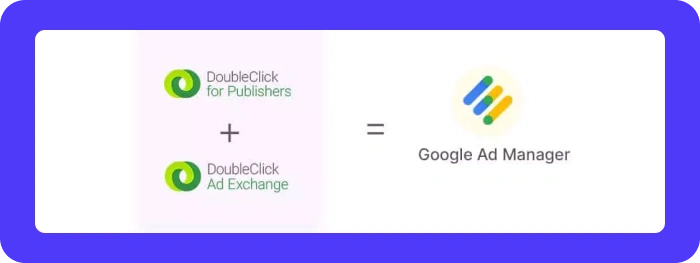
With GAM, publishers can define, monitor, and manage their web, mobile, and app inventory all in one place and have the option to include AdSense and AdX to compete for impressions. The platform also allows publishers to create, update, and deliver line items, manage sales, send invites for direct deals, and accept insertion orders. Publishers can control when and where the ad appears, set price floors, and even block advertisers from bidding on their inventories.
Additionally, GAM is equipped to comply with the latest privacy regulations like GDPR and CCPA, making it an ideal choice for publishers looking to maximize their ad revenue and increase efficiency in ad management.
Read our complete guide about Google Ad Manager For Publishers.
Google Ad Manager 360 (GAM 360) is a cloud-based paid platform of GAM used by enterprise publishers or publishers with higher traffic volumes. The platform offers everything provided by GAM, with additional features such as multi-screen ad delivery and advanced reporting.
As a premium publisher, you also get different integrations such as Data Studio, DMP (Data Management Platform) integration, Open Bidding, special ad units, CPA (Cost Per Action), and vCPM (Viewable Cost Per Impression) based campaigns, audience segmentation and many more.
Learn more about Google Ad Manager 360.
Despite their similarities, Google Ad Manager and Google Ad Manager 360 are two distinct platforms. Both platforms work with Google Analytics, AdSense, and Ad Exchange to provide a seamless experience in managing online advertising.
However, the two platforms differ in their features and capabilities, with Google Ad Manager 360 offering more advanced options for high-volume publishers. Other differences include,
Pricing
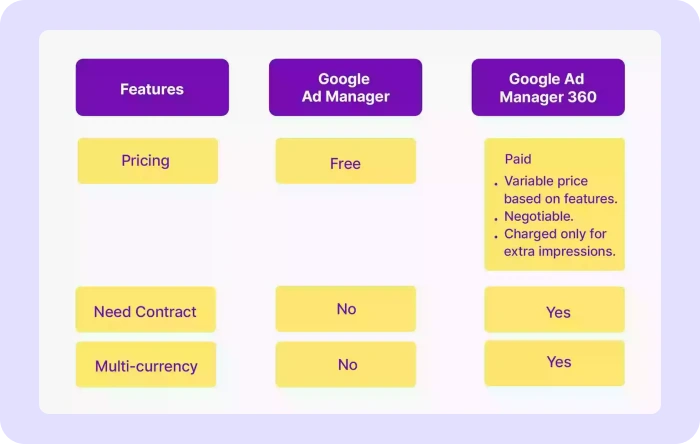
Inventory & Trafficking
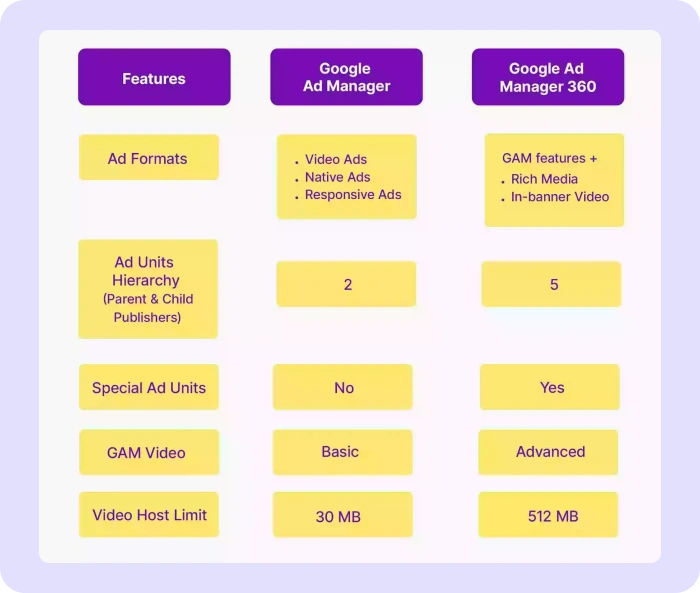
Monetization & Support
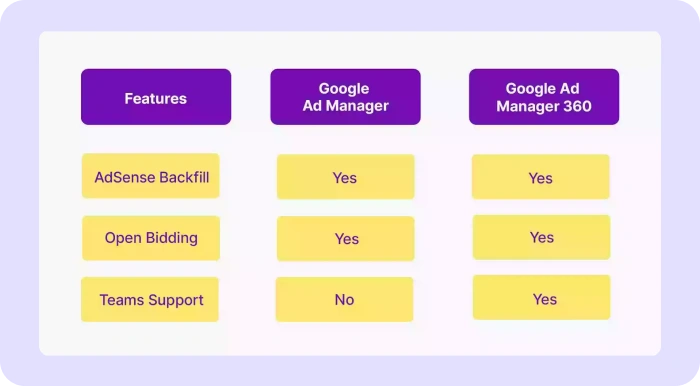
Integration & Reporting
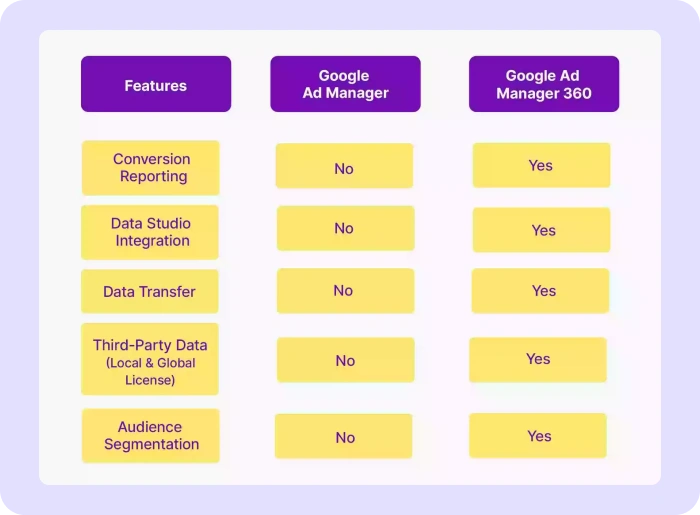
In 2025, Google Ad Manager’s free monthly usage thresholds (90 M non-video impressions, with regional variations and 800 K video impressions) still determine whether your account remains in the basic tier. However, exceeding those thresholds doesn’t automatically “switch” you to GAM 360. Instead, publishers work directly with Google sales or a certified partner to activate billing and negotiate a GAM 360 contract that accommodates higher volumes and advanced features. Access to GAM 360 features such as Open Bidding, advanced audience management, and enhanced reporting is based on an eligibility and contract process rather than automatic account conversion.
While both Google Ad Manager and Google Ad Manager 360 provide you with the tools you need to manage your advertising campaigns effectively and maximize your revenue, there are some key differences between the two.
As a publisher, you should carefully consider your needs, goals, and budget when deciding which platform is right for you. For larger enterprises with more complex monetization and management needs, GAM 360 may be the better option, while independent publishers may find GAM a more cost-effective solution.

To set up video ads in Google Ad Manager (GAM), publishers must first create video ad units and generate VAST tags. Next, configure placements, define inventory sizes, and set targeting criteria. You then create line items (direct or programmatic), attach video creatives, and traffic them to the appropriate ad units. For in-stream video, a video player with VAST or IMA SDK integration is required. Publishers should also configure frequency caps, price floors, and privacy settings (GDPR/CCPA consent signals via cookie banners). Proper setup ensures optimized delivery, reporting accuracy, and minimal impact on Core Web Vitals.
Google Ad Manager supports in-stream, out-stream, rewarded, skippable, and non-skippable video ads. In-stream ads run within video content, while out-stream ads appear inside articles without a video player. Publishers can monetize these formats through direct deals, private marketplaces, and programmatic demand via Ad Exchange or Open Bidding (GAM 360).
The key difference between in-stream and out-stream video ads is placement. In-stream ads play within a video player and interrupt or accompany video content, typically delivering higher CPMs due to strong viewer attention. Out-stream ads appear outside a video player, such as in-article, in-feed, or scroll-activated placements, allowing publishers to monetize pages without video content. While in-stream inventory is premium, out-stream video helps expand monetization across editorial pages and increases incremental revenue.
Publishers monetize video ads in GAM by selling inventory through direct deals, private marketplaces (PMPs), programmatic guaranteed campaigns, and open auctions via Ad Exchange. They can set price floors, enable header bidding or Open Bidding (GAM 360), and optimize demand competition. Revenue models include CPM, vCPM (viewable CPM), and CPA campaigns.

.webp)


.avif)
.avif)


