

Ad Technologies

In 2025, VAST is still the standard for delivering video ads. SIMID and OMID have replaced VPAID as the industry moves to safer, more reliable ad technology.
Video ads have grown tremendously over the past years and are poised to continue the trend. The latest report by Statista declared that advertisers would spend $104.87 billion in the US this year.
With video ads becoming increasingly popular, it is no wonder there are large debates about VPAID vs. VAST ad tags. Which is best for video ads? What’s the difference between them?
In this post, I’ll try to explain why these two standards have taken off in the digital advertising world and how they’re actually different from one another and give insight into which may be best for your business.
VAST and VPAID are video ad-serving protocols, meaning there are different rules on how a video ad should be delivered to the user. IAB (Interactive Advertising Bureau) framed the protocols to ensure the industry players have a standard way to interpret, deliver, and measure video ad campaigns.
Moreover, VAST and VPAID are not mutually exclusive. For the delivery of video ads, you will be using VAST in every case. The addition of VPAID is just the addition of new features to the already existing VAST framework. Let’s dive into the differences. Shall we?
VAST stands for Video Ad Serving Template. It helps with the communication between the ad server and the video player on the website.
Before the arrival of VAST, the ads had to be custom programmed according to the video players of the publishers, which hampered the ability to scale up video ad serving.
VAST tags are the foundation of an online video ad service, but understanding the technical details behind them is important for publishers looking to optimize their ad budgets. Let's understand the underlying processes of VAST tags, explore definitions, available versions, and consider its limitations.
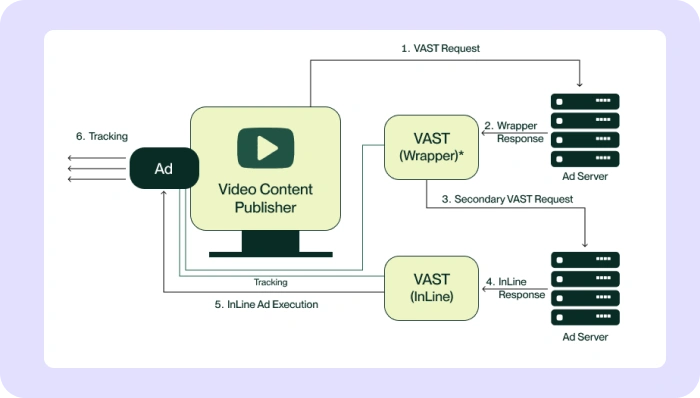
VAST tags are a three-step process:
The IAB has continuously improved the VAST standard over time. Here's a quick rundown of the current versions:
It's important to note that VAST tags are backward compatible, ensuring a smooth flow within the ad-serving ecosystem.
While VAST tags are a powerful tool, they do have some limitations:
Despite these limitations, VAST tags remain the basis of online video ad serving. Their standardized approach ensures smooth communication between ad servers and video players, ultimately enabling a seamless video ad experience for viewers. Want to know more? Here’s our detailed VAST guide.
VPAID (Video Player Ad-Serving Interface Definition) was an early IAB standard created to enable executable, interactive video ad experiences beyond what traditional VAST media files allowed. However, as of 2025, VPAID is officially deprecated by the IAB Tech Lab and is no longer recommended for new integrations.
The deprecation is driven by several structural limitations that became increasingly problematic as programmatic video expanded across mobile, CTV, and server-side ad insertion (SSAI) environments:
As a result, the industry has transitioned to newer, purpose-built standards:
For publishers and programmatic leaders, VPAID should be considered a legacy technology and avoided in future-facing video ad stacks.
VPAID versions are no longer actively developed or maintained. Instead, the IAB Tech Lab and the broader programmatic ecosystem now rely on SIMID and OMID, which were designed to solve the exact challenges VPAID could not scale to address.
SIMID enables rich interactive ad experiences while preserving publisher control of the video player. Interactive logic runs in a secure sandbox separate from media playback, making it compatible with web, mobile, and CTV environments.
OMID provides a standardized framework for viewability, verification, and fraud measurement across devices and platforms. It allows measurement vendors to collect consistent signals without requiring executable ad code.
For publishers, this shift improves:
SIMID replaces VPAID for interactivity, and OMID replaces VPAID for measurement.
VAST acts as the foundational delivery layer that integrates with SIMID and OMID to support interactive and measurable video advertising at scale.
For publishers and programmatic leaders, this architecture ensures:
The modern video ad stack is VAST + SIMID + OMID.
VPAID should not be used for new integrations, as it is deprecated and unsupported in many modern video environments.

.webp)


.avif)
.avif)


