

Ad Technologies

Header Bidding and Open Bidding both increase competition for ad inventory, but they differ in auction location, control, latency, and revenue impact.
Two pillars of programmatic advertising that marketers still struggle to differentiate between: Open bidding and Header bidding. Who’s the winner?
Header bidding severed the long-standing dependency on Google for ad monetization with flexibility and level-play, which is why Google gave a counterattack with Open bidding.
Both technologies serve the same purpose and efficiency, which is the same reason that makes it hard to differentiate and understand each to choose the right one. This blog gives answers to these very perplexions and explains the significant differences. By the end, you will know the way to choose the right technique that gives high CPMs and ad revenue.
So, let’s get started.
But before learning about differences, let’s understand what do they mean
Header bidding or pre-bidding is an advanced programmatic technology where you can open your premium inventories to multiple demand partners (both guaranteed and non-guaranteed line items) simultaneously to bid and place ads.
Header bidding can be done both on the client side and on the server side, where it sends requests directly from the website to demand partners or from the ad server to demand partners.
Google’s Open Bidding is a server-side unified auction where several ad exchanges and SSPs compete with Google’s Ad Exchange (AdX) to win the impressions, just like header bidding. In open bidding, one request from the site to Google Ad Manager (GAM), the ad server, is enough. Further, the GAM will take over the process of finding the highest bid among Google AdX and non-Google ad partners.
The first and main difference between header and open bidding is the auction process; let's take a brief look at the differences between each process:
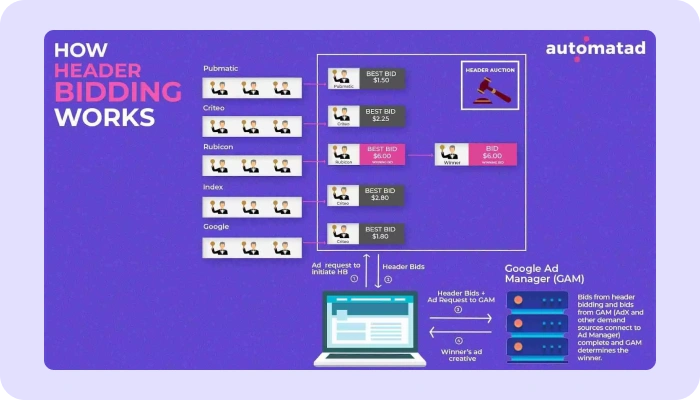
As mentioned before, in the header bidding process, ad requests from your ad server are sent to several demand partners simultaneously. Each time an ad request is sent, the header tag initiates the auction, collects bids from all demand partners, and then passes the highest bid to the ad server.
Now, the ad server compares the highest bid with sponsored, direct, or programmatic deals and serves the ad creative to the user. Since the received bids are made to compete with the ad server’s demand, it substantially increases your eCPM and revenue.
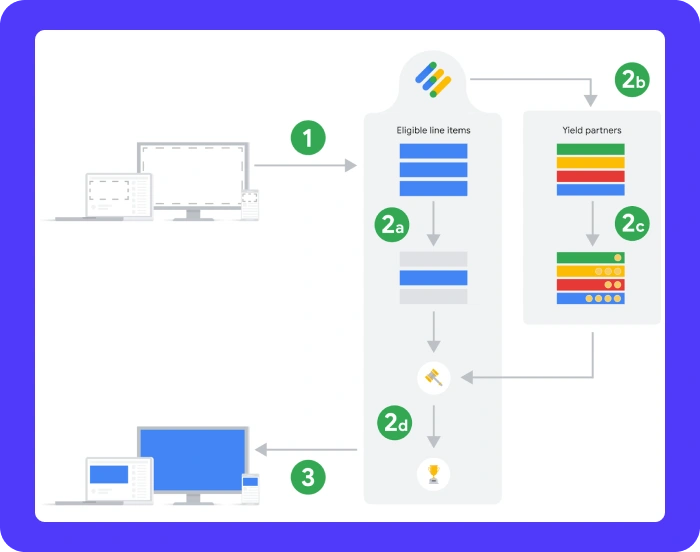
Google’s Open Bidding is a server-side unified auction where several ad exchanges and SSPs can compete with Google’s Ad Exchange (AdX) to win impressions, just like header bidding. The only difference is that the auction occurs on the server rather than the client.
To be frank, Open Bidding was a counter punch by Google to Header Bidding vendors. Google even dropped its last-look advantage in Open Bidding to make itself more friendly.
The main difference is that the auction will happen inside GAM (ad server), not on the users’ browser. Here’s what the process looks like:
Besides the difference in processes, their features, pros, and cons widely vary
Here’s a quick overview of it with the comparison table.
Both have their pros and cons. For instance, header bidding will be completely transparent and can be managed or customized by publishers. And, with the availability of open-source header bidding technologies like Prebid, it has become much easier to implement and execute header bidding.
On the other hand, Open Bidding helps you to deal with page latency. As we’ve shifted the auction to the server side, the number of ad requests and wait time can be reduced. But the server takes care of the auction, and publishers have no control here.
Both techniques may differ in latency and control attributes, but they possess high efficiency and auction performance.
Therefore, it depends on your needs whether you are going to choose high demand, efficiency, and control or high demand, efficiency, and low latency. You can find the right fit for you in two different cases: Choose either one with testing or Choose both.
It doesn’t hurt to test and try each technique separately for a stipulated period and compare the outputs. This way, you can find the right one with the quantitative results of your website rather than relying on documented numbers.
What I mean by choosing both is to implement hybrid header bidding. Through this technique, you get to use both client-side and server-side open bidding. Thereby, you can increase the demand and revenue.
In both cases, choosing hybrid header bidding might seem like a great choice. But again, the great choice stays so if it suits your revenue goal and website technicalities.
So, overall, the strategy lies in testing combinations and comparing results. Eventually, you will be driven to the right pick that gives high impression values and overall ad revenue.
Auction efficiency relies on many parameters that have to be essentially optimized: floor price, bidder count, and bidder timeout.
Ultimately, these two bidding solutions offer the same advantages: bidding opportunities for the demand partners, better CPMs, and ad revenue for the publisher.
There are pros and cons to both Open Bidding and header bidding, so the right solution will ultimately depend on what you’re looking for. If you can’t seem to decide between the two, consider them both as options, as they can ultimately coexist within your ad server.
Fortunately, you’re never obligated to choose one over the other—make the call that works best for your setup, even if it’s called something different. You can always change course in the future if you find yourself wishing you had picked a different solution from the get-go.

There’s no one-size-fits-all winner. the best choice depends on your goals. Header bidding often delivers higher revenue and greater control because it runs simultaneous auctions with many demand partners and provides full bid transparency. Open Bidding, however, is easier to manage and reduces latency since the auction happens server-side through Google Ad Manager. Many publishers use a hybrid setup to balance revenue, speed, and simplicity.
Open Bidding is a server-side unified auction within Google Ad Manager where multiple ad exchanges, SSPs, and demand partners compete in real time for available impressions. The ad server sends all eligible partners into a single auction, compares bids alongside direct deals and AdX, and serves the highest bid. This reduces page latency and simplifies demand partner management.
In many cases, yes. Header bidding can generate higher revenue because it creates transparent, parallel competition among multiple demand sources before the ad server makes its final decision. This often increases eCPMs and reduces reliance on a single exchange like AdX. Publishers also gain more granular control over floor prices, bidder timeouts, and partner selection using wrappers like Prebid. However, revenue results depend on traffic quality, demand diversity, setup optimization, and compliance factors such as cookie consent and data availability in privacy-regulated regions.
Open Bidding offers several operational and performance advantages: Server-side auctions that reduce browser workload Faster page load times and better Core Web Vitals Unified billing and reporting through Google Easier technical setup compared to client-side header bidding Access to multiple SSPs without managing separate contracts Because Google manages partner integrations and payments, publishers face less technical overhead. This makes Open Bidding attractive for teams with limited engineering resources or those prioritizing page speed and simplified yield management.

.webp)


.avif)
.avif)


